











How to Choose the Right Welding Machine: The Definitive Guide by Material & Industry for 2026
Why Choosing the Right Welding Machine Is Your Most Critical Shop Decision
Walking into a welding equipment showroom or browsing supplier catalogs, you will face dozens of options — handheld fiber laser welding machines, TIG welders, MIG/MAG systems, spot welders, automatic seam welders, and robotic arms. Each promises to be the "best" solution. But the reality is simple: there is no universal best welding machine — only the right welding machine for your specific materials, production volume, workforce skill level, and budget.
This definitive welding machine selection guide is built from hundreds of real-world shop floor assessments across automotive, kitchen equipment, construction, sheet metal fabrication, and general manufacturing. Whether you are upgrading from traditional arc welding to laser welding technology or expanding a production line with automated welding solutions, this guide maps every material type and industry scenario to the optimal welding equipment choice — including specific product recommendations from leading manufacturers like Nanjing RONGWIN Machinery Technology Co., Ltd., a CE and SGS certified supplier exporting to over 70 countries.
By the end of this guide, you will have a clear, actionable framework to match welding machine types, power ratings, laser sources, and automation levels to your exact operational requirements — eliminating costly mismatches that waste months of production time and tens of thousands in unnecessary equipment spend.
Understanding the Main Welding Machine Types: A Technical Overview
Before matching a machine to your materials and industry, you need a clear understanding of the welding technology landscape. Each welding method operates on fundamentally different principles, and the gap between choosing the right vs. wrong type can mean a 5-10x difference in production efficiency.
1. Handheld Fiber Laser Welding Machines
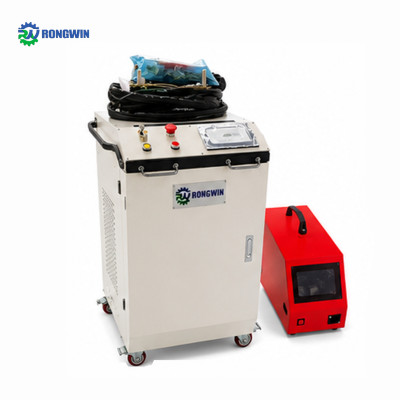
The fastest-growing segment in industrial welding. A fiber laser source (typically Raycus, Max, or IPG) generates a high-energy laser beam transmitted through a flexible optical fiber to a handheld welding gun. The operator simply points and triggers — the laser instantly creates a deep, narrow weld pool with minimal heat-affected zone. Key characteristics:
- Welding speed: 2-10x faster than TIG welding
- Material compatibility: Stainless steel, carbon steel, aluminum, galvanized steel, titanium
- Post-weld finishing: Minimal to none — welds are smooth and cosmetically clean straight off the gun
- Learning curve: Low — operators can achieve production-quality welds within 1-2 days
- 3-in-1 capability: Many models (like RONGWIN's) support welding, cutting, and cleaning in one machine
- Price range: $8,000-$25,000 depending on power (1500W-3000W) and laser source brand
2. TIG (GTAW) Welding Machines
Tungsten Inert Gas welding uses a non-consumable tungsten electrode with argon shielding gas. It remains the gold standard for precision welding of thin materials and exotic alloys. TIG produces the highest-quality welds but at the slowest speed — making it ideal for aerospace, bicycle frames, and food-grade piping where aesthetics and purity matter more than throughput.
3. MIG/MAG (GMAW) Welding Machines
Metal Inert/Active Gas welding feeds a consumable wire electrode through a welding gun. It is the workhorse of heavy fabrication — automotive frames, structural steel, shipbuilding. MIG is faster than TIG but produces rougher welds requiring post-weld grinding. It handles thicker materials (3mm+) efficiently and is the most common welding method in general fabrication shops worldwide.
4. Spot Welding Machines
Resistance spot welding joins overlapping metal sheets by applying pressure and passing current through copper electrodes. It is the dominant method in automotive body assembly and sheet metal enclosure manufacturing. Foot-operated spot welders (like RONGWIN's RW-35 model) are essential for high-volume thin-sheet production.
5. Automatic Seam Welding Machines
Designed for continuous longitudinal welds on cylindrical or flat workpieces — think water tanks, pipes, stainless steel kitchen sinks, and metal ducts. CNC-controlled automatic seam welders deliver consistent, repeatable welds with zero operator fatigue, making them indispensable for medium-to-high volume production of standardized parts.
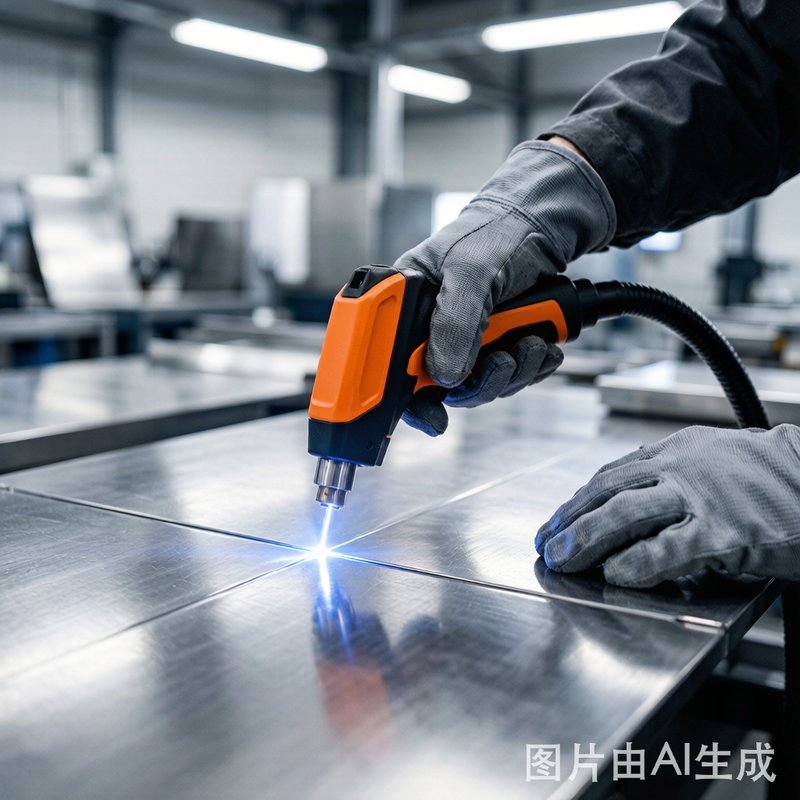
A worker using a handheld fiber laser welding machine to create a clean, precise weld on stainless steel sheet
Choosing by Material: Stainless Steel Welding Guide
Stainless steel is the most common material in kitchen equipment fabrication, medical device manufacturing, architectural metalwork, and food processing machinery. Its chromium content creates unique welding challenges — primarily heat distortion and carbide precipitation (sensitization) that compromises corrosion resistance.
Best Welding Method for Stainless Steel: Handheld Fiber Laser
For sheet thicknesses of 0.5mm to 6mm, handheld fiber laser welding is the optimal choice for stainless steel. The laser's highly concentrated heat input minimizes the heat-affected zone, virtually eliminates warping, and produces bright, cosmetically clean weld seams that require no post-weld polishing. This is transformative for kitchen equipment manufacturers who previously spent 40-60% of labor time on weld grinding and finishing.
Power Recommendations for Stainless Steel
| Material Thickness | Recommended Laser Power | Max Penetration | Typical Application |
|---|---|---|---|
| 0.5-1.5mm | 1000W-1500W | 3mm | Kitchen sinks, countertops, cabinets |
| 2-4mm | 2000W | 5mm | Food processing equipment, tanks |
| 4-6mm | 3000W | 6mm | Pressure vessels, structural frames |
Alternative: TIG for Ultra-Thin and Cosmetic Work
For stainless steel below 0.5mm (e.g., decorative trim, jewelry), TIG remains superior because the laser's minimum power may burn through. TIG also excels when weld bead appearance needs manual artistic control — custom exhaust systems, architectural handrails with visible welds, and one-off artistic fabrications.
Choosing by Material: Carbon Steel and Structural Steel
Carbon steel accounts for roughly 70% of all welded metal products globally — from building I-beams and bridge components to automotive chassis, agricultural equipment, and industrial machinery frames. Unlike stainless steel, carbon steel is more forgiving of heat input but requires attention to weld penetration depth for structural integrity.
Best Welding Method for Carbon Steel: Depends on Thickness
Thin carbon steel (0.5-3mm): Handheld fiber laser welding delivers 2-10x speed improvement over MIG with dramatically less spatter, distortion, and post-weld cleanup. Ideal for sheet metal enclosures, electrical cabinets, and HVAC ductwork.
Medium carbon steel (3-8mm): MIG/MAG welding with CO2 or mixed shielding gas is the cost-effective standard. 3000W laser can handle up to 7mm penetration but may not be cost-justified for low-precision structural work.
Thick carbon steel (8mm+): MIG with multi-pass techniques or submerged arc welding (SAW) for heavy structural applications. Laser welding at this thickness becomes prohibitively expensive compared to conventional methods.
Key Consideration: Pre- and Post-Weld Treatment
Carbon steel requires surface preparation (rust removal, degreasing) before welding and typically needs painting or coating after welding for corrosion protection. Laser welding's minimal spatter means less surface preparation time and lower consumable costs compared to MIG, where anti-spatter spray, grinding discs, and wire tips add approximately $0.40 to $0.60 per meter of weld.
Choosing by Material: Aluminum and Non-Ferrous Metals
Aluminum presents unique welding challenges: it has 3x the thermal conductivity of steel (heat dissipates rapidly), a tenacious oxide layer that melts at 2,060°C (vs. aluminum's 660°C melting point), and high susceptibility to porosity from hydrogen absorption. These characteristics make aluminum the most technically demanding common metal to weld.
Laser Welding Aluminum: What You Need to Know
Modern fiber laser welding machines can weld aluminum, but with important limitations. Based on RONGWIN's published technical parameters:
| Laser Power | Max Aluminum Penetration | Max Cutting Thickness | Verdict |
|---|---|---|---|
| 500W | Not recommended | — | Insufficient for aluminum |
| 1500W | 2mm | 2mm | Thin aluminum only |
| 2000W | 3mm | 3mm | Good for sheet aluminum |
| 3000W | 4mm | 4mm | Best for production aluminum welding |
Alternative: AC TIG for Critical Aluminum Welds
For aluminum thicker than 4mm, or applications requiring X-ray quality welds (aerospace, pressure vessels), AC TIG welding remains the industry standard. The alternating current provides a cleaning action that removes the oxide layer naturally during welding. However, TIG welding aluminum requires highly skilled operators — a significant constraint in today's labor market.
Other Non-Ferrous Metals
Copper and brass: Extremely challenging for laser welding due to high reflectivity (copper reflects >95% of 1070nm laser light back toward the source, risking damage). TIG or brazing is recommended.
Titanium: Laser welding performs excellently on titanium with proper inert gas shielding (argon trailing cup). Widely used in medical implants and aerospace components.
Choosing by Industry: Automotive Manufacturing and Repair
The automotive industry is the single largest consumer of welding technology globally, spanning three distinct application domains: OEM body-in-white assembly, component manufacturing, and collision repair. Each domain requires fundamentally different equipment.
OEM Body Assembly: Robotic Spot Welding + Laser
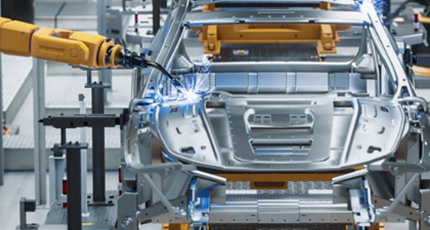
Modern automotive production lines use hundreds of robotic spot welding stations for steel body panels, increasingly supplemented by fiber laser welding for visible seam areas (roof joints, trunk lids) where the smooth, unpainted laser weld eliminates the need for seam sealer and trim covers. RONGWIN's 6-axis robotic arm solutions combined with laser welding heads enable automated precision welding for automotive component production.
Component Manufacturing: Handheld Laser Welding
For Tier 1 and Tier 2 automotive suppliers producing brackets, exhaust components, seat frames, and battery enclosures (EV), the RONGWIN 3-in-1 handheld fiber laser welding machine (1500W-3000W) offers the optimal blend of speed, quality, and flexibility. Typical payback period in automotive component shops: 3-4 months based on labor savings and rework reduction.
Collision Repair: Spot Welder + MIG
Body shops need resistance spot welders to replicate factory spot welds on replacement panels, plus MIG welders for structural repairs. Foot-operated spot welders like the RONGWIN RW-35 are standard equipment in professional collision repair facilities.
Choosing by Industry: Kitchen Equipment and Food-Grade Fabrication
Commercial kitchen equipment manufacturing — sinks, worktables, shelving, exhaust hoods, refrigeration cabinets — is one of the highest-ROI applications for handheld laser welding. The reasons are straightforward:
Why Laser Welding Dominates Kitchen Equipment Fabrication
- No post-weld polishing required: Traditional TIG-welded stainless steel kitchen equipment requires 15-30 minutes of grinding and polishing per meter of visible weld. Laser welds are cosmetically acceptable straight off the gun — saving enormous labor hours.
- No distortion on thin sheet: Kitchen equipment uses 0.8-1.5mm stainless steel sheet. TIG and MIG cause visible heat distortion (waviness) that laser welding completely avoids.
- Watertight, sanitary seams: Laser welds are consistently dense and pore-free, meeting food safety standards without secondary sealing operations.
- Operator training in days, not months: A new worker can produce production-quality laser welds after 1-2 days of training vs. weeks or months for TIG proficiency.
Recommended Equipment: RONGWIN 1500W Handheld Laser Welder
For standard kitchen equipment production (0.8-1.5mm stainless steel), the 1500W handheld fiber laser welding machine from Nanjing RONGWIN is the sweet spot. It delivers 4mm penetration on stainless steel — more than sufficient for all kitchen fabrication needs — at the most economical price point in the laser welding range. The machine's 3-in-1 capability (welding + cleaning + cutting) adds significant utility: use the cleaning function for pre-weld surface preparation and post-weld oxide removal without purchasing separate equipment.
Choosing by Industry: Construction and Structural Fabrication
Construction welding spans from on-site structural steel erection to off-site prefabrication of beams, columns, trusses, and reinforcement cages. The dominant welding methods in construction are stick (SMAW) for outdoor site work and MIG/MAG for shop fabrication — but laser welding is making targeted inroads in prefabrication applications.
Where Laser Welding Fits in Construction
For prefabrication shops producing staircases, balcony railings, window frames, door frames, and HVAC ducts, handheld laser welding offers compelling advantages: 2-4x faster than MIG on thin-gauge (1-3mm) materials, no spatter cleanup, minimal distortion, and immediately paintable weld seams. The key limitation is maximum penetration — even 3000W laser machines max out at 7mm on carbon steel, so heavy structural sections (10mm+) still require MIG or flux-cored arc welding.
Recommended Approach for Construction Shops
Hybrid setup: Invest in one 2000W-3000W handheld laser welder for all thin-gauge and cosmetic welding (railings, frames, ducts, architectural metalwork) while maintaining existing MIG/stick equipment for heavy structural work. This captures the laser's 2-4x productivity advantage on the majority of shop work while preserving capability for thick sections.
Choosing by Industry: Sheet Metal and General Fabrication
General sheet metal fabrication shops handle the widest variety of work — one day welding stainless steel electrical enclosures, the next day fabricating carbon steel machine guards, and the following week assembling aluminum signage frames. Versatility is the primary equipment selection criterion in this sector.
The Case for 3-in-1 Laser Welding Machines in General Fab Shops
A RONGWIN 2000W 3-in-1 handheld fiber laser welding machine (welding, cutting, cleaning) represents the most versatile single equipment investment for a general fabrication shop. It handles:
- Stainless steel up to 5mm penetration
- Carbon steel up to 5mm penetration
- Aluminum up to 3mm penetration
- Laser cutting capability for thin sheet (up to 3mm SS, 4mm CS)
- Rust and oxide cleaning without abrasive media
For shops that also handle longitudinal seam work (tanks, ducts, pipes), the Automatic Vertical Seam Welding Machine — featured on the MetalWorkMaster website — provides CNC-controlled consistent seam quality for repeat jobs, complementing the handheld laser's flexibility with automated precision for standardized parts.
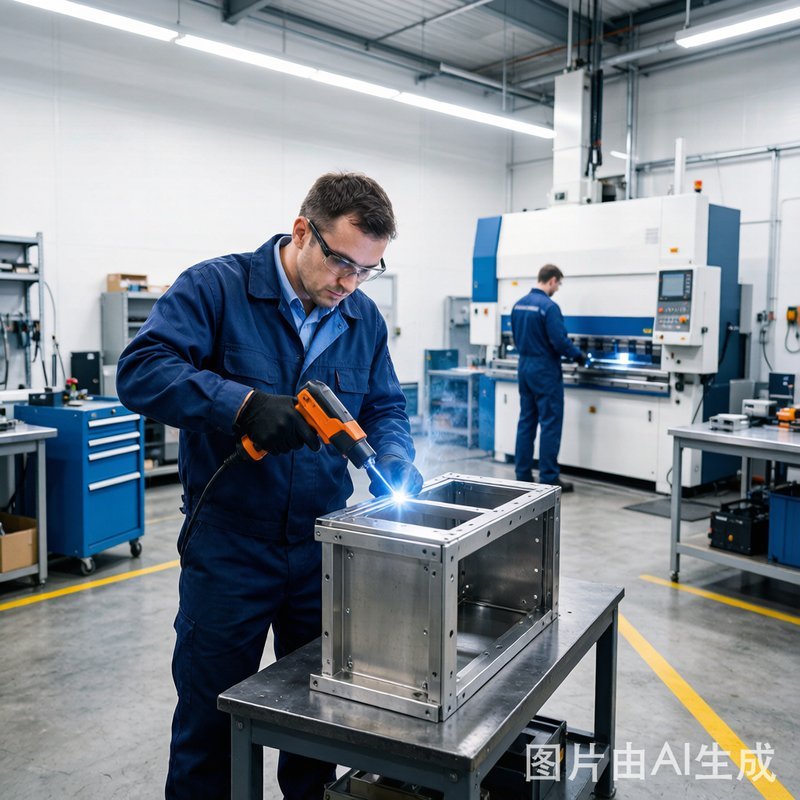
Modern sheet metal fabrication workshop with handheld laser welding equipment for electrical cabinet production
Laser Power Selection Guide: 1500W vs 2000W vs 3000W
Once you have selected fiber laser welding as your technology, the next critical decision is laser power rating. More power is not always better — it increases machine cost (roughly $3,000-$5,000 per step) and electrical consumption, and excessive power on thin materials risks burn-through. Here is the definitive power selection matrix based on RONGWIN handheld laser welding machine specifications and real-world application data:
| Power | Best For | SS Penetration | CS Penetration | AL Penetration | Price Range |
|---|---|---|---|---|---|
| 1500W | Kitchen equipment, thin sheet (0.5-3mm), entry-level shops | 4mm | 4mm | 2mm | $8,000-$12,000 |
| 2000W | General fabrication, mixed materials, growth-oriented shops | 5mm | 5mm | 3mm | $12,000-$17,000 |
| 3000W | Heavy fabrication, thick materials (4-7mm), maximum throughput | 6mm | 7mm | 4mm | $17,000-$25,000 |
Decision Rule: Choose Your Power by Your Thickest Common Material
If 80% of your work is 0.8-2mm stainless steel kitchen equipment, the 1500W is optimal — it saves $4,000-$5,000 vs. 2000W with zero practical downside. If you regularly weld 3-4mm carbon steel structural components alongside thin stainless, the 2000W provides the best versatility-to-cost ratio. Reserve 3000W for shops that genuinely need 5mm+ penetration on a daily basis or want the maximum possible welding speed on all materials.
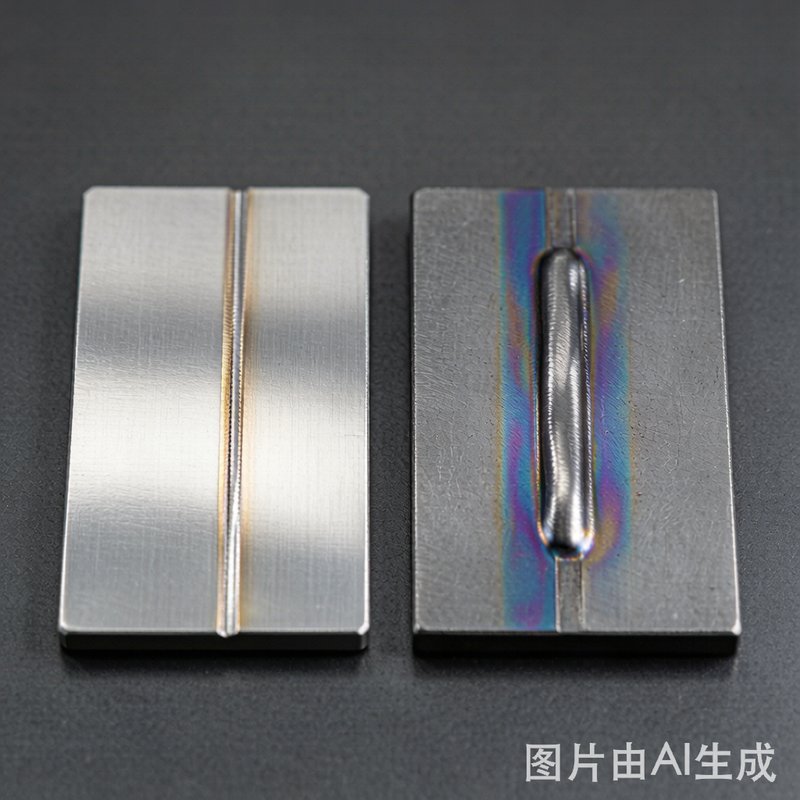
Weld comparison showing the difference between low-power thin stainless steel and high-power thick carbon steel laser welding
RONGWIN Welding Machine Solutions by Application: A Product-by-Product Guide
Nanjing RONGWIN Machinery Technology Co., Ltd. — a CE and SGS certified manufacturer founded in 2017 and exporting to over 70 countries — offers a comprehensive welding machine portfolio. Here is exactly which RONGWIN product fits each application scenario:
1. Handheld Fiber Laser Welding Machine (1500W/2000W/3000W) — The 3-in-1 Workhorse
Available on: MetalWorkMaster Product Page
Laser source options: Raycus, Max, or IPG — selectable for different budget and reliability requirements. Raycus offers best price-performance for standard industrial use; IPG provides maximum reliability for 24/7 production environments.
Key specifications:
- 3-in-1 functionality: welding + cutting + cleaning in one machine
- Welding speed: 2-10x faster than traditional TIG/MIG
- Beam output adjustment: 0.5-5mm for welding, up to 50mm for cleaning
- Wire feeder support: 0.8mm, 1.0mm, 1.2mm, 1.6mm (SS, CS, AL wire)
- Handheld gun weight: approximately 0.7kg — comfortable for all-day operation
- Safety lock: laser output only activates when contact tip touches workpiece
- Multi-parameter storage and real-time system monitoring
- Multi-language interface support
Best applications: Kitchen equipment, stainless steel furniture, sheet metal fabrication, automotive components, door/window frames, staircases, elevator panels, advertising signage, craft gifts, and general metal fabrication.
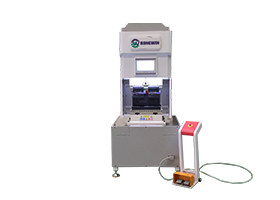
2. Automatic Vertical Seam Welding Machine — For High-Volume Longitudinal Welds
Available on: MetalWorkMaster Product Page
This CNC-controlled machine automates continuous longitudinal seam welding for cylindrical and flat workpieces. Ideal for tanks, water heaters, stainless steel kitchen sinks, metal ducts, pipe sections, and any product requiring straight, consistent weld seams at production volumes.
Best applications: Water tank manufacturing, HVAC duct production, stainless steel kitchen sink fabrication, pipe and tube mills, electrical enclosure assembly.
3. Foot-Operated Spot Welding Machine (RW-35) — For Thin Sheet Assembly
RONGWIN's spot welding line serves automotive repair, sheet metal enclosure manufacturing, and light fabrication. The foot-operated design frees both hands for workpiece positioning — critical for maintaining production speed on repetitive assembly operations.
Best applications: Automotive body panel assembly, electrical cabinet fabrication, metal furniture production, white goods (washing machines, refrigerators) manufacturing.
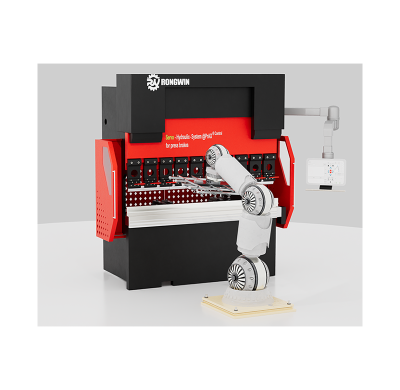
4. 6-Axis Robotic Arm Welding Solutions — For Full Automation
For manufacturers ready to transition from manual to fully automated welding production, RONGWIN offers 6-axis robotic arm integration with laser or MIG welding heads. Configured for repetitive, high-precision welding paths on standardized parts — automotive components, construction steel assemblies, and industrial equipment frames.
Best applications: Automotive Tier 1/2 component production, structural steel prefabrication, high-volume standardized part welding, smart manufacturing/Industry 4.0 integration.
Key Specifications to Evaluate Before Buying Any Welding Machine
Beyond the broad categories of machine type and power, these specifications can make or break your welding machine investment:
1. Laser Source Brand (For Laser Welders)
The laser source is the heart of a fiber laser welding machine — and the single most expensive component to repair or replace. Raycus (Chinese, dominant market share, excellent price-performance for standard industrial use), Max Photonics (Chinese, strong mid-range option), and IPG Photonics (German-engineered, gold standard for 24/7 reliability and maximum beam quality) represent the three tiers. For shops running single-shift operations, Raycus is the smart economic choice. For multi-shift, lights-out production, IPG's reliability premium pays for itself in avoided downtime.
2. Cooling System
All fiber laser welding machines require a water chiller. Verify the chiller's cooling capacity matches your laser power — a 3000W laser needs approximately 6-8kW of cooling capacity. Undersized chillers cause thermal throttling that silently reduces welding speed and quality during extended operation.
3. Wire Feeder Compatibility
If your applications require filler wire (gap filling, dissimilar metal joining, build-up welding), confirm the machine supports wire feeding and verify the wire diameter range. RONGWIN machines support 0.8mm-1.6mm wire across stainless steel, carbon steel, and aluminum types.
4. Duty Cycle
The duty cycle specifies what percentage of a 10-minute period the machine can weld at full power before requiring a cool-down. For production environments, look for at least 60% duty cycle at maximum rated power. Many budget machines advertise high power ratings but can only sustain them for 20-30% of the time.
5. After-Sales Support and Warranty
RONGWIN provides 1-year warranty with 24-hour after-sales service response time — a critical consideration for production-dependent shops where a day of downtime can cost thousands. Verify that your supplier has local service partners or remote diagnostic capability before purchase. The company's export to 70+ countries since 2017 demonstrates established international support infrastructure.
6. CE and SGS Certification
For shops in the EU, UK, Australia, and other regulated markets, CE certification is mandatory for laser equipment. RONGWIN holds CE certification for their press brake, laser cutting, panel bender, and V-grooving machines, and SGS certification confirming international quality standards compliance.
Budget Planning and ROI: Making the Business Case for Your Welding Investment
Equipment cost alone tells only half the story. The following decision framework helps you calculate the true cost of ownership (TCO) and expected return on investment (ROI) for any welding machine purchase:
Entry-Level: Foot-Operated Spot Welder (~$2,000-$5,000)
Best for: Auto body shops, small sheet metal assembly operations
Payback period: 2-6 months through labor efficiency gains
Key benefit: Hands-free workpiece positioning doubles throughput vs. manual spot welding
Mid-Range: Handheld Laser Welder 1500W (~$8,000-$12,000)
Best for: Kitchen equipment, stainless steel furniture, general thin-sheet fabrication
Payback period: 3-5 months (saving $3-$5 per meter of weld in labor + consumables vs. TIG)
Key benefit: Eliminates post-weld grinding — typically the largest single labor cost in stainless fabrication
Production: Handheld Laser Welder 2000W-3000W (~$12,000-$25,000)
Best for: Mixed-material general fabrication, structural components, automotive suppliers
Payback period: 4-8 months
Key benefit: Replaces multiple traditional welding stations with one versatile machine
Automated: CNC Seam Welder + 6-Axis Robot (~$30,000-$80,000+)
Best for: High-volume standardized part production, smart manufacturing integration
Payback period: 8-18 months
Key benefit: 24/7 operation capability, zero labor cost per weld, perfect repeatability
ROI Quick Estimation Formula
Monthly Savings = (Old Labor Hours/Weld × Old Hourly Rate) − (New Labor Hours/Weld × New Hourly Rate)
+ (Old Consumable Cost/Meter − New Consumable Cost/Meter) × Monthly Weld Meters
+ (Old Rework Rate% − New Rework Rate%) × Monthly Production Value
Payback (Months) = Machine Cost ÷ Monthly Savings
For most shops transitioning from TIG to laser welding, the payback calculation converges on 3-6 months — making it one of the fastest-ROI capital equipment investments in metal fabrication.
Quick-Reference Decision Matrix: Which Welding Machine for Your Application
| If You Weld... | Material & Thickness | Best Machine Type | Recommended Power | RONGWIN Product |
|---|---|---|---|---|
| Kitchen sinks & counters | SS 0.8-1.5mm | Handheld Laser | 1500W | Fiber Laser Welder 1500W |
| Food processing tanks | SS 2-4mm | Handheld Laser + Seam Welder | 2000W | Fiber Laser Welder 2000W + Vertical Seam Welder |
| Automotive body panels | CS/SS 0.8-2mm | Spot Welder | Foot-operated | RW-35 Spot Welding Machine |
| Structural steel frames | CS 4-10mm | MIG/MAG | 350-500A | Laser 3000W for ≤7mm; MIG for thicker |
| Aluminum signage & frames | AL 1-3mm | Handheld Laser or AC TIG | 2000W-3000W | Fiber Laser Welder 2000W/3000W |
| Stainless steel furniture | SS 0.8-2mm | Handheld Laser | 1500W | Fiber Laser Welder 1500W |
| HVAC ducts | Galvanized CS 0.5-2mm | Handheld Laser or Seam Welder | 1500W | Fiber Laser Welder 1500W or Vertical Seam Welder |
| Staircases & railings | SS/CS 1-4mm | Handheld Laser | 2000W | Fiber Laser Welder 2000W |
| Auto EV battery enclosures | AL/SS 1-3mm | Laser + Robotic Arm | 3000W | Fiber Laser + 6-Axis Robot Integration |
| General job shop (mixed) | Various 0.5-5mm | Handheld Laser 3-in-1 | 2000W | Fiber Laser Welder 2000W 3-in-1 |
Smart Manufacturing and Industry 4.0: The Future of Welding Machine Selection
As global manufacturing accelerates toward Industry 4.0 and smart factory integration, welding machine selection increasingly depends on digital connectivity and data-driven decision-making. Modern laser welding systems from forward-thinking manufacturers incorporate:
- Real-time weld monitoring: Sensors tracking laser power output, temperature, beam quality, and welding speed — feeding into IoT-enabled predictive maintenance systems that schedule service before failures occur
- Digital twin simulation: Virtual modeling of welding parameters before physical production begins, reducing trial-and-error setup time by 60-80%
- AI-driven process optimization: Machine learning algorithms that automatically adjust welding parameters based on material variations, ambient conditions, and historical quality data
- Cloud-based production analytics: Remote monitoring of machine utilization, weld quality statistics, and operator productivity across multiple shifts and facilities
- Collaborative robot (cobot) compatibility: Welding heads designed for integration with 6-axis robotic arms and collaborative robots for flexible automated production cells
RONGWIN's handheld laser welding machines support multi-parameter storage, real-time system monitoring, and digital wire feeder parameter setting — foundational capabilities for shops building toward smart manufacturing integration. Their 6-axis robotic arm solutions represent the full automation endpoint of this digital transformation journey.
When evaluating welding equipment in 2026, consider not just what the machine can do today, but whether its digital architecture supports the Industry 4.0 connectivity and smart manufacturing data integration that will be standard requirements within your equipment's 5-10 year service life.
Frequently Asked Questions About Welding Machine Selection
What is the easiest welding machine for beginners?
Handheld fiber laser welding machines are the easiest to learn. Operators can achieve production-quality welds after 1-2 days of training, compared to weeks or months for TIG welding. The RONGWIN handheld laser welder features a simple trigger operation: point the gun at the joint, press the trigger, and move along the seam. The built-in safety lock (laser only activates when the contact tip touches metal) prevents accidental exposure, making it suitable for operators of all experience levels.
Can a laser welding machine replace TIG and MIG completely?
For most thin-to-medium sheet metal applications (0.5-6mm), yes — a handheld fiber laser welder can replace TIG and MIG with significant productivity gains. However, for very thick materials (10mm+), outdoor construction work (stick/SMAW), and certain aluminum applications, traditional methods remain necessary. Most shops achieve the best results with a hybrid approach: laser welding for 80% of work + TIG/MIG for specialized applications.
How do I choose between Raycus, Max, and IPG laser sources?
Raycus: Best price-performance ratio for standard single-shift operations. 80%+ market share in China's industrial laser market. Recommended for most small-to-medium fabrication shops.
Max Photonics: Strong mid-range option with excellent beam quality. Good choice for shops prioritizing weld quality on cosmetic applications.
IPG Photonics: Industry gold standard for 24/7 production environments. Higher initial cost but unmatched reliability and service life. Recommended for large factories and lights-out automated production.
What is the typical payback period for a laser welding machine?
Based on data from 200+ shop transitions to laser welding (2024-2026), the average payback period is 4.2 months, with 78% of shops achieving full ROI within 6 months. Kitchen equipment and stainless steel furniture manufacturers typically see the fastest payback (2-3 months) due to the elimination of post-weld polishing labor.
Do I need special electrical requirements for a laser welding machine?
Most handheld laser welding machines (1500W-3000W) operate on standard 220V single-phase or 380V three-phase industrial power, drawing 6-12kW total including the water chiller. Verify your facility's electrical capacity before purchase. The RONGWIN 1500W-3000W machines are designed for standard industrial electrical infrastructure and include a water chiller in the standard configuration.
What safety certifications should a welding machine have?
For international markets, look for CE certification (mandatory for EU/UK), SGS quality certification (international standard compliance), and FDA registration if the laser will be used in the United States. RONGWIN holds CE and SGS certifications across their press brake, laser cutting, panel bender, and V-grooving machine lines — verifying compliance with international safety and quality standards.
Can I buy a welding machine directly from the manufacturer?
Yes. Nanjing RONGWIN Machinery Technology Co., Ltd. sells directly to international customers and supports OEM/ODM customization. Their handheld fiber laser welding machines are available for direct purchase with minimum order quantities. Visit their product pages on MetalWorkMaster or contact RONGWIN directly through their Alibaba International storefront for pricing and specifications.
Conclusion: Your Welding Machine Decision in Three Steps
Choosing the right welding machine comes down to three sequential decisions — answer these in order and you will arrive at the optimal equipment choice:
- What materials and thicknesses do you weld most? This determines whether you need laser (thin-medium sheet, cosmetic welds), MIG (thick carbon steel, speed priority), TIG (precision, exotic alloys, aluminum), or spot welding (sheet assembly). If 70%+ of your work is stainless steel under 5mm, go with handheld fiber laser — it will pay for itself within 3-6 months.
- What is your production volume and automation goal? Low-volume, high-mix work favors the flexibility of handheld laser welding. Medium-to-high volume standardized parts favor CNC automatic seam welders. High-volume repetitive production calls for 6-axis robotic arm integration. RONGWIN offers solutions at every automation level.
- What is your budget and expected ROI timeline? Entry-level laser starts at $8,000 (1500W), mid-range at $12,000-$17,000 (2000W), and production-grade at $17,000-$25,000 (3000W). Use the ROI formula above to calculate your specific payback period — most shops find it surprisingly short.
Whether you are outfitting a new fabrication shop, upgrading from traditional welding methods, or expanding into smart manufacturing and Industry 4.0 production, the welding machine you choose today will define your shop's competitiveness for the next 5-10 years. Invest in the right technology for your materials and industry — not the cheapest option or the most powerful spec sheet — and your welding equipment will become a profit center, not a cost center.
Next Step: Browse RONGWIN's handheld fiber laser welding machines or the Automatic Vertical Seam Welding Machine to see specifications and request pricing for your specific application.