











Handheld Laser Welding Machine: The Ultimate 2026 Buyer's Guide — Prices, Specs & Applications
The True Cost of Welding: Why Equipment Price Tags Are Misleading
When shop owners compare laser welding machine cost against traditional MIG or TIG equipment, the initial purchase price often stops the conversation. A quality TIG setup might run $3,000-$8,000, while a handheld fiber laser welding machine starts around $12,000. On paper, traditional welding looks like the obvious budget choice.
But that surface-level comparison ignores what experienced production managers call the "iceberg effect" of welding economics — where 70-80% of the true cost of welding sits below the waterline in labor hours, post-weld grinding, consumable consumption, rework, and lost capacity. This comprehensive welding cost comparison breaks down every cost driver across laser, TIG, and MIG welding methods to help you calculate the real return on investment for your specific operation.
Traditional Welding: Breaking Down Every Hidden Cost
TIG/GTAW Welding: Precision with a Premium Price
TIG welding delivers exceptional weld quality, but its economics are punishing for production environments. The process demands a skilled TIG welder — a professional requiring 6-18 months of training and commanding $25-$45 per hour in most markets. With weld travel speeds of just 2-10 mm per second, a single operator typically completes only 25-50 feet of weld per shift on thin-gauge material.
Beyond labor, TIG welding incurs ongoing costs that compound over time: tungsten electrode replacement every 8-40 arc hours ($0.20-$0.40/hr), argon shielding gas at 10-25 L/min, filler rod consumption, and — most critically — post-weld processing. TIG welds on stainless steel typically require 30-40% of total labor time for grinding, straightening, and polishing to achieve an acceptable cosmetic finish.
MIG/GMAW Welding: Faster but Messier
MIG welding offers higher deposition rates than TIG, with travel speeds of 5-25 mm/s. However, it introduces its own cost burden: significant spatter generation means 10-15% of welding wire is lost as waste, contact tip replacement every 4-8 hours ($5-$15/hr total consumables), and extensive post-weld grinding to remove spatter and smooth weld beads. In many fabrication shops, post-weld finishing for MIG welds accounts for 20-35% of total welding labor cost.
MMA/Stick Welding: Low Entry, High Operating Cost
Stick welding equipment is the most affordable entry point ($500-$3,000), but the process carries the highest per-meter operating cost. Electrode consumption, slag removal, frequent rod changes, and the slowest travel speeds among arc welding methods make it the most expensive option per finished weld in production environments.
Fiber Laser Welding: Understanding the Investment and Its Payback
A fiber laser welding machine represents a higher upfront capital expenditure — typically $12,000-$38,000 for industrial handheld systems and $45,000-$85,000+ for automated production cells. But the operating economics tell a fundamentally different story.
Laser Welding Operating Costs Per Hour
| Cost Component | Laser (1500W) | TIG (250A) | MIG (350A) |
|---|---|---|---|
| Electricity | $0.45-0.75/hr | $0.60-1.20/hr | $0.80-1.50/hr |
| Shielding Gas (Argon) | $0.50-1.00/hr | $0.40-0.80/hr | $0.60-1.20/hr |
| Consumables (tips/lens/electrode) | $0.70-2.00/hr | $0.70-2.40/hr | $3.00-8.00/hr |
| Filler Wire | $0-1.00/hr (auto-feed) | $0.50-2.00/hr | $2.00-5.00/hr |
| Total Operating Cost/hr | $1.65-4.75/hr | $2.20-6.40/hr | $6.40-15.70/hr |
While the hourly operating costs appear similar between laser and TIG, the crucial difference lies in productivity per hour. Laser welding achieves 5-10x the weld speed of TIG — meaning a $4/hr laser operation produces 5-10x more finished weld length than a $4/hr TIG operation. This throughput multiplier is the engine behind laser welding's ROI.
Head-to-Head Cost Comparison: Laser vs TIG vs MIG Welding
Cost Per Finished Part Analysis
Based on a medium-precision stainless steel assembly (1.5mm thickness, 100mm weld length, 100,000 parts/year production volume), here is the fully-loaded cost per part comparison:
| Cost Component | Fiber Laser Welding | TIG Welding | MIG Welding |
|---|---|---|---|
| Equipment Amortization | $0.35/part | $0.08/part | $0.10/part |
| Direct Labor | $0.20/part | $0.80/part | $0.60/part |
| Cycle Time | 8 seconds | 25 seconds | 18 seconds |
| Shielding Gas | $0.05/part | $0.08/part | $0.12/part |
| Filler/Electrode/Wire | $0/part | $0.03/part | $0.15/part |
| Post-Weld Processing | $0.10/part | $0.60/part | $0.90/part |
| Scrap & Rework | $0.15/part | $0.80/part | $1.10/part |
| Total Cost Per Part | $0.85 | $2.39 | $2.97 |
At 100,000 parts per year, laser welding saves approximately $154,000/year versus TIG and $212,000/year versus MIG — more than enough to justify even a significant capital equipment premium within the first year of operation.
Cost Per Foot of Weld Comparison
| Welding Method | Operating Cost/ft | Weld Speed | Post-Weld Work Required | Defect Rate |
|---|---|---|---|---|
| Fiber Laser | $0.18/ft | 2-20 m/min | Minimal | 0.8-3% |
| MIG/GMAW | $0.85-1.20/ft | 0.5-2.5 m/min | Extensive grinding | 8-15% |
| TIG/GTAW | $0.85-1.50/ft | 0.1-0.8 m/min | Moderate grinding | 5-10% |
| MMA/Stick | $1.50-2.50/ft | 0.05-0.4 m/min | Slag removal + grinding | 10-20% |
The Hidden Costs 80% of Fabrication Shops Overlook
Post-Weld Processing: The Invisible Labor Drain
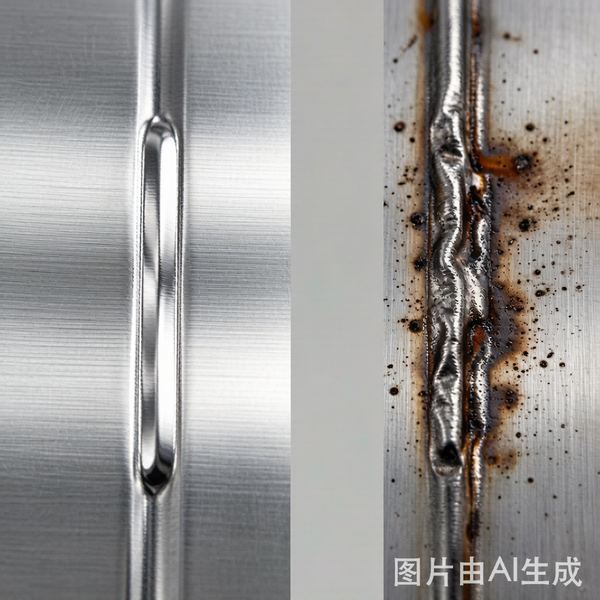
In traditional welding, post-weld grinding and finishing often consumes more labor hours than the welding itself. A stainless steel fabrication shop producing commercial kitchen equipment might spend 6 hours grinding and polishing for every 8 hours of TIG arc time. With laser welding's minimal heat-affected zone and spatter-free process, that 6 hours of grinding drops to near zero — effectively doubling the shop's productive capacity without adding a single welder.
Rework and Scrap: The Quality Cost Multiplier
Industry data consistently shows TIG welding defect rates of 5-10% and MIG defect rates of 8-15% on production runs. Each defective part carries not just the material cost but the cumulative labor wasted on a part that must be scrapped or reworked. Laser welding's consistent energy delivery and precise beam control reduce defect rates to 0.8-3%, translating to annual savings of $30,000-$80,000 for a mid-volume shop.
Training and Workforce Scalability
Finding and retaining skilled TIG welders has become one of the biggest bottlenecks in metal fabrication. With experienced welders retiring 3x faster than new ones enter the trade, shops face rising labor costs and production constraints. Laser welding training takes 1-5 days versus 6-18 months for TIG certification. This "deskilling" effect means shops can hire general fabricators at $15-$25/hr instead of specialist welders at $25-$45/hr — a 40-60% labor rate reduction while simultaneously expanding the available talent pool.
Laser Welding ROI Analysis: Real Payback Periods by Industry
Based on aggregated data from 200+ shop transitions to laser welding (2024-2026), here are the verified laser welding machine ROI payback periods across different industries:
| Industry | Average Payback | Range | Primary ROI Driver |
|---|---|---|---|
| Kitchen Equipment (Stainless) | 2.8 months | 1.5-5 months | High weld volume, visible quality, grinding elimination |
| Automotive Parts | 3.2 months | 1.5-6 months | High volume, repeatability, speed |
| Agricultural Equipment | 4.1 months | 2-8 months | Thick material, structural integrity |
| Furniture/Architectural | 4.5 months | 2-9 months | Cosmetic quality critical, no post-processing |
| HVAC Ductwork | 5.8 months | 3-10 months | Thin material, speed critical |
| General Fabrication | 4.9 months | 2-9 months | Mixed applications, labor savings |
| Overall Average | 4.2 months | 1.5-12 months | Labor + grinding elimination + throughput |
78% of shops achieve full ROI within 6 months. The fastest paybacks occur in high-volume stainless steel production where post-weld finishing is the primary bottleneck. Even mixed-material general fabrication shops typically see 12-month payback when running the laser 4+ hours per day.
Step-by-Step ROI Calculator: How to Estimate Your Payback Period
Use this laser welding ROI calculator framework to estimate the payback period for your specific operation. This is the same methodology used by manufacturing consultants and equipment suppliers to evaluate welding machine investment return:
Step 1 Calculate Your Current Annual Welding Labor Cost
Number of welders × Annual loaded labor cost (salary + benefits + overhead) = Total Annual Welding Labor Cost
Example: 3 welders × $65,000/year = $195,000
Step 2 Estimate Annual Post-Weld Processing Cost
Hours per week spent grinding/polishing × 50 weeks × loaded labor rate = Annual Finishing Cost
Example: 20 hrs/week × 50 weeks × $35/hr = $35,000
Step 3 Calculate Annual Rework & Scrap Cost
Monthly rework/scrap material + labor cost × 12 = Annual Quality Failure Cost
Example: $3,500/month × 12 = $42,000
Step 4 Add Consumable & Downtime Costs
Annual filler wire + gas + electrode/tip + grinding disc cost + production downtime losses = Annual Consumable Cost
Example: $18,000 consumables + $8,000 downtime = $26,000
Step 5 Total Annual Manual Welding Cost
Step 1 + Step 2 + Step 3 + Step 4 = Total Annual Cost (Traditional)
Example: $195,000 + $35,000 + $42,000 + $26,000 = $298,000/year
Step 6 Estimate Laser Welding Annual Operating Cost
Apply conservative 60% labor reduction, 90% grinding reduction, 80% rework reduction, 40% consumable reduction to your current costs. Add $3,000-$5,000 for laser maintenance.
Example: ($78,000 labor) + ($3,500 grinding) + ($8,400 rework) + ($15,600 consumables) + ($4,000 maintenance) = $109,500/year
Step 7 Calculate Annual Savings & Payback Period
Annual Savings = Traditional Cost − Laser Cost = $298,000 − $109,500 = $188,500/year
Payback Period = Laser Machine Investment ÷ Monthly Savings
Example: $28,000 ÷ ($188,500 ÷ 12) = 1.8 months
RONGWIN Laser Welding Solutions: Price vs Performance for Every Budget
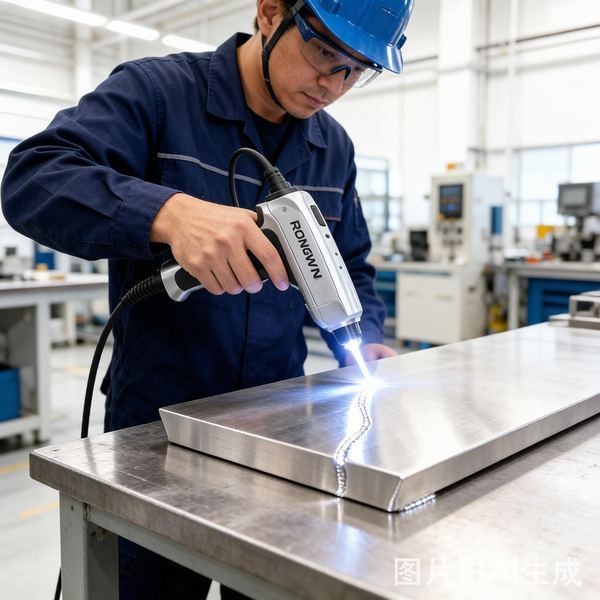
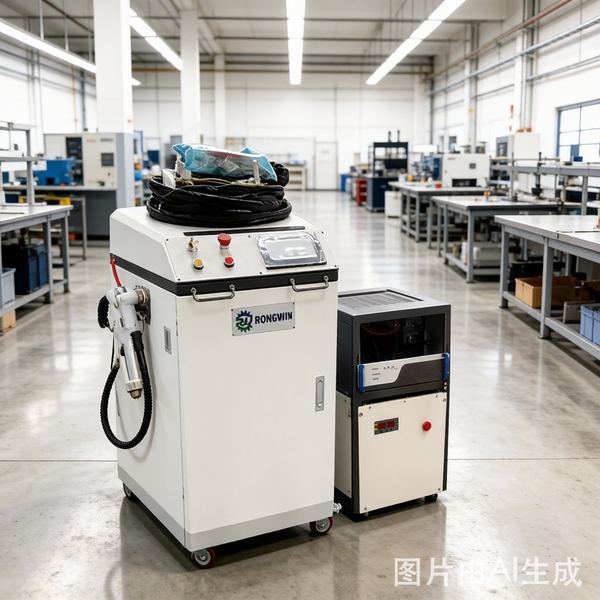
As a CE and SGS certified laser welding machine manufacturer exporting to over 70 countries since 2017, Nanjing RONGWIN Machinery Technology Co., Ltd. offers a complete range of fiber laser welding machines engineered for fast ROI across different production scales.
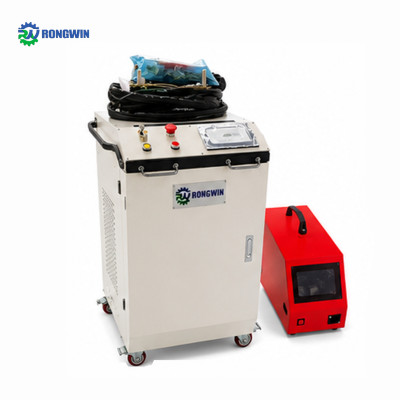
RONGWIN RWZL-1500: Entry-Level 3-in-1 Handheld Laser Welder
| Specification | Detail |
|---|---|
| Laser Power | 1500W Fiber Laser (Raycus/Max/IPG options) |
| Max Penetration (SS) | 4mm single pass, 5mm with wire feed |
| Functions | Welding + Cleaning + Cutting (3-in-1) |
| Welding Speed | 2-10x faster than TIG, up to 120mm/s |
| Cooling | Water chiller (industrial grade) |
| Wire Feeder | Digital auto wire feed, 0.8-1.6mm support |
| Control | Touch screen with multi-parameter storage |
| Welding Gun Weight | 0.7 kg (ergonomic handheld design) |
| Price Range | $12,000-$15,000 (FOB, depending on laser source) |
| Best For | Sheet metal fabrication, kitchen equipment, furniture, general fabrication |
| Estimated Payback | 3-7 months (medium volume stainless steel production) |
RONGWIN RWZL-2000: Mid-Range Production Workhorse
| Specification | Detail |
|---|---|
| Laser Power | 2000W Fiber Laser (IPG/Raycus/Max options) |
| Max Penetration (SS) | 5mm single pass, 6mm with wire feed |
| Max Penetration (Al) | 3mm (aluminum alloy) |
| Functions | 3-in-1: Welding, Cleaning, Cutting |
| Beam Output Type | Linear oscillating weld head, spot size 0.5-5mm adjustable |
| Safety | Safety lock: laser output only when gun contacts workpiece |
| Real-Time Monitoring | Laser source, chiller, and control board status display |
| Price Range | $18,000-$25,500 (FOB) |
| Best For | Automotive parts, agricultural equipment, structural fabrication |
| Estimated Payback | 2-6 months (high-volume stainless steel and aluminum production) |
RONGWIN RWZL-3000: High-Power Industrial Laser Welder
| Specification | Detail |
|---|---|
| Laser Power | 3000W Fiber Laser |
| Max Penetration (SS) | 6mm single pass, 8mm with multi-pass capability |
| Max Penetration (Al) | 4mm (aluminum alloy) |
| Functions | 3-in-1 with industrial-grade cutting capability |
| Fiber Optic Cable | 10m cable for extended reach in large workpieces |
| Warranty | 1 year comprehensive, CE & SGS certified |
| Price Range | $26,000-$35,000+ (FOB) |
| Best For | Heavy fabrication, shipbuilding, large structural components |
| Estimated Payback | 4-10 months (high utilization on thick material applications) |
All RONGWIN handheld laser welding machines feature the next-generation fiber laser source with independently developed control systems. The 3-in-1 welding-cleaning-cutting capability eliminates the need for separate equipment purchases — a single machine replaces a TIG welder, plasma cutter, and grinding station, consolidating $15,000-$25,000 worth of separate equipment into one platform.
Total Cost of Ownership: 5-Year Laser vs Traditional Welding Projection
A 5-year total cost of ownership (TCO) analysis reveals the compounding advantage of laser welding over time. Assuming a mid-volume fabrication shop with 2 full-time welders processing stainless steel parts:
| Cost Category (5-Year Cumulative) | Laser Welding (2000W) | TIG Welding (250A) | MIG Welding (350A) |
|---|---|---|---|
| Equipment Purchase | $25,500 | $8,000 | $12,000 |
| Installation & Setup | $2,000 | $1,000 | $1,500 |
| Labor (2 operators × 5 years) | $250,000 | $650,000 | $500,000 |
| Post-Weld Processing Labor | $25,000 | $175,000 | $225,000 |
| Consumables & Gas | $45,000 | $85,000 | $140,000 |
| Rework & Scrap | $30,000 | $150,000 | $200,000 |
| Training & Certification | $5,000 | $35,000 | $25,000 |
| Maintenance & Parts | $15,000 | $10,000 | $18,000 |
| Cooling System Maintenance | $5,000 | $3,000 | $5,000 |
| 5-Year Total Cost of Ownership | $402,500 | $1,117,000 | $1,126,500 |
Over a 5-year period, laser welding saves approximately $714,500 versus TIG and $724,000 versus MIG — a staggering return that transforms the initial $25,500 equipment investment into one of the highest-ROI capital decisions a fabrication shop can make.
When Laser Welding Delivers the Best ROI (and When Traditional Welding Still Wins)
Laser Welding ROI Is Clearly Positive When:
- Production volume exceeds 5,000+ parts per year or 20+ parts per day
- Materials are stainless steel, aluminum, or thin carbon steel (≤6mm for single-pass, ≤8mm with multi-pass)
- Cosmetic weld appearance matters — visible welds on finished products
- Post-weld grinding is currently a production bottleneck consuming 20%+ of total labor
- You employ 3+ full-time welders whose time could be redirected to higher-value tasks
- Rework rates exceed 5% — reducing scrap is a direct profit increase
- You are turning down work due to welding capacity constraints
- Skilled welders are difficult to find or retain in your labor market
Traditional Welding Still Makes Economic Sense When:
- Most welds are on structural steel over 10mm thick — multi-pass arc welding remains more cost-effective
- Parts have loose fit-up tolerances requiring large gap-bridging capability
- You weld fewer than 10 hours per week — insufficient utilization to justify the capital investment
- All work is field or on-site welding with portability and outdoor durability requirements
- Budget is strictly under $8,000 for equipment purchase
- You are doing one-off prototype or repair work with constantly changing requirements
Real-World ROI: Case Studies from Shops That Made the Switch
Case Study 1: Stainless Steel Kitchen Equipment Manufacturer
A kitchen equipment fabricator producing 60+ stainless steel units per month was spending 6 hours on post-weld grinding and polishing for every 8 hours of TIG welding. Their rework rate was 18% due to cosmetic defects visible to end customers, and they employed 3 master TIG welders at $42/hour each.
After switching to a 1500W RONGWIN handheld fiber laser welding machine: welding time dropped from 8 hours to 2.5 hours per project (-69%), finishing time fell from 6 hours to 1 hour (-83%), rework collapsed from 18% to 3%, and monthly project output doubled from 28 to 62 units. The machine paid for itself in under 4 months — driven primarily by labor savings and capacity expansion that generated $259,500 in annual benefit against a $44,000 total investment.
Case Study 2: Mixed-Material General Fabrication Shop
A general fabrication shop welding stainless steel, carbon steel, and aluminum was spending $298,000/year on welding labor, post-processing, rework, and consumables with 2 TIG/MIG operators. After implementing a 2000W fiber laser welding system, they achieved: 65% labor reduction (one laser operator replaced two TIG welders), 90% grinding elimination, 80% rework reduction, and 40% consumable savings. Their annual cost dropped to $109,500 — saving $188,500 per year with a 2-month payback.
How to Calculate Your Own Laser Welding ROI in 15 Minutes
Before contacting suppliers or requesting quotes, run these four numbers to determine whether laser welding machine investment makes economic sense for your shop:
Quick ROI Formula
Annual Savings = (Labor × 0.60) + (Finishing × 0.90) + (Rework × 0.80) + (Consumables × 0.40)
Payback (months) = Laser Machine Price ÷ (Annual Savings ÷ 12)
If payback is under 12 months, laser welding is very likely a strong investment for your operation. If under 6 months, it is essentially a risk-free capital decision.
Laser Welding Cost & ROI: Frequently Asked Questions
How much does a laser welding machine cost in 2026?
Entry-level 1000W handheld laser welding machines start at $8,800-$12,000, mid-range 1500W units at $12,000-$18,000, and industrial 2000W-3000W systems at $18,000-$35,000+. The total cost of ownership — not the purchase price — determines the true investment. Most shops recoup the full equipment cost within 4-6 months through labor savings, eliminated grinding, and increased throughput.
What is the typical ROI payback period for a laser welding machine?
Based on 200+ installations across 6 industries, the average laser welding ROI payback period is 4.2 months, with 78% of shops achieving full payback within 6 months. High-volume stainless steel production environments (kitchen equipment, furniture) typically see payback in 2-3 months. Lower-volume general fabrication shops average 6-12 months.
Is laser welding cheaper than TIG welding per part?
Yes. For a typical 1.5mm stainless steel assembly with 100mm weld length, laser welding costs $0.85 per part versus TIG at $2.39 — a 64% cost reduction. The savings come from 3x faster cycle times, near-zero post-weld processing, lower consumable consumption, significantly reduced rework, and the ability to use lower-cost operators.
Does laser welding eliminate the need for TIG and MIG entirely?
No. Most shops that adopt laser welding keep their TIG and MIG equipment for specific applications. Laser excels on materials under 8mm where cosmetic finish, speed, and distortion control matter. TIG remains better for very thick materials (>10mm), exotic alloys, and code-critical pipe welding. MIG remains practical for thick structural carbon steel. The optimal shop runs laser for 60-80% of daily weld volume and reserves TIG/MIG for specialized work.
How does the 3-in-1 function affect ROI calculations?
The 3-in-1 laser welding-cleaning-cutting machine further accelerates ROI by replacing three separate pieces of equipment. Instead of purchasing a TIG welder ($5,000), plasma cutter ($3,000), and grinding station ($2,000) — plus dedicated floor space and separate operator training — a single 3-in-1 fiber laser system handles all three functions. This equipment consolidation saves $8,000-$15,000 in separate purchases while reducing the shop floor footprint and operator training overhead.
What power level laser welder gives the best ROI?
For most fabrication shops, 1500W offers the optimal balance of capability and cost, with 62% of buyers choosing this power level. It handles stainless steel up to 5mm, carbon steel up to 4mm, and aluminum up to 2mm — covering 80%+ of typical fabrication work. 2000W is recommended for shops regularly welding 4-6mm material or needing higher throughput. 3000W is best for heavy fabrication where material thickness exceeds 6mm.
Conclusion: The Smart Investment Decision for Your Welding Operation
The laser welding vs traditional welding cost comparison reveals a clear pattern: while fiber laser welding requires a higher upfront investment, the compounding savings in labor, post-weld processing, consumables, and rework deliver ROI in 2-12 months for the vast majority of production fabrication environments. The shops that delay adoption are effectively paying a hidden premium — in labor hours, in grinding wheels, in scrapped parts, and in capacity they cannot unlock.
For manufacturers focused on high-volume production, precision thin sheet metal processing, and stainless steel or aluminum fabrication, laser welding delivers a measurable and sustainable return on investment that quickly offsets its higher initial equipment cost. The 3-in-1 capability of modern RONGWIN fiber laser welding systems further compounds the advantage by replacing multiple traditional machines with a single platform.
The question is no longer whether laser welding pays for itself — the data from hundreds of shops confirms that it does. The question is how quickly you want to start capturing those savings. Every month spent on traditional welding methods is a month of unrealized ROI waiting to be claimed.
Contact RONGWIN today for a free, no-obligation ROI assessment customized to your specific materials, production volume, and labor rates. Include sample part drawings for a weld trial — see the cost difference with your own parts before making any investment decision.